How to Identify ADU-Friendly Lots in Burbank
June 25, 2026
June 25, 2026
If you are house hunting in Burbank with ADU potential in mind, you already know the challenge: two homes can look similar on paper, but only one may be a realistic fit for a future accessory dwelling unit. That can make the search feel confusing, especially when zoning, setbacks, parking rules, and overlays all come into play. The good news is that Burbank has clear ADU standards, and with the right screening process, you can spot stronger opportunities early. Let’s dive in.
Burbank has become a meaningful ADU market. The city’s housing element notes 542 ADU building permits were issued from 2019 through 2021, including 322 permits in 2021 alone.
That momentum matters if you are buying for multigenerational living, future flexibility, or value-add potential. It also means you should look beyond lot size alone, because in Burbank, configuration and site conditions often matter more than the raw square footage of the parcel.
Burbank allows ADUs on R-1, R-1-H, R-2, R-3, R-4, MDR-3, and MDR-4 lots, as well as on lots with existing single-family or multifamily residential units. Even so, not every residential lot is equally workable.
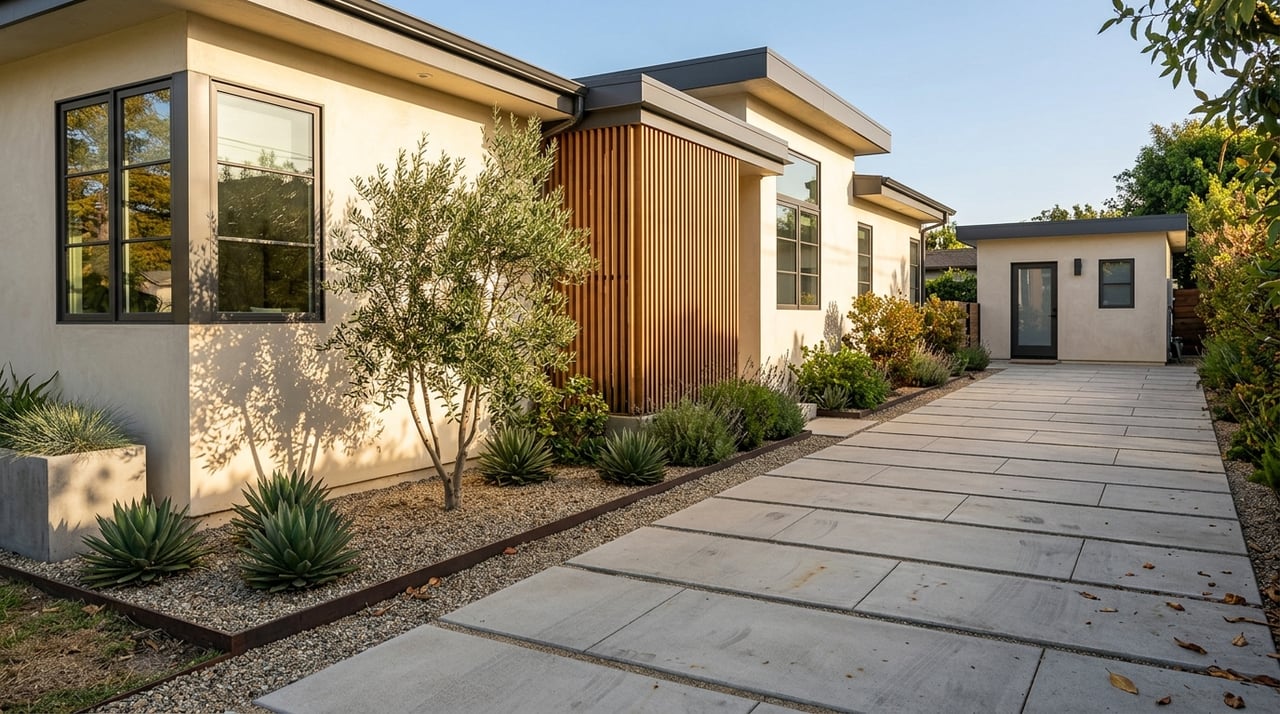
In many Burbank scenarios, the easiest lots to work with are the ones that have usable backyard area and side-yard access. The city generally requires 4-foot rear and side setbacks for ADUs, along with 5-foot wall-to-wall separation and 4-foot eave-to-eave separation from nearby structures.
That means a deep lot with open buildable area can give you more design flexibility. It can also make construction staging easier, which matters if you want fewer layout compromises.
A lot may look promising from the front, but side access often tells the real story. If there is practical room along the side of the home, it may be easier to reach the rear yard, plan a detached unit, or convert an existing structure.
This is one of those details that can affect both design and day-to-day function. A tighter lot is not automatically ruled out, but it may require more creative planning.
One of the strongest ADU signs is an existing detached garage, carport, guest structure, or other accessory building with conversion potential. Burbank allows conversions, and if parking is removed as part of the conversion or demolition, the city does not require that parking to be replaced.
For buyers, that can open a simpler path than starting from the ground up. For sellers, this is often one of the most practical future-use features to highlight when marketing a property.
A usable driveway or alley setup can make a lot easier to plan. Burbank also has specific entrance orientation rules for detached ADUs visible from the street, so access and placement matter together.
If an ADU faces an alley, Burbank allows an alley-facing entrance when it is at least 5 feet from the alley line and another entrance faces the front or side. These details are not always obvious during a quick showing, which is why lot layout matters as much as house condition.
Parking is one of the first things buyers worry about, but in some Burbank locations, it may be less of a problem than expected. The city says ADU parking is not required when the property is within one-half mile walking distance of public transit or when the street requires a parking permit.
When parking is required, Burbank may allow tandem parking and parking within an existing driveway or setback area in many cases. So if you are comparing two homes, one near transit may offer a smoother path than a similar home farther away.
A lot is not truly ADU-friendly unless the allowed unit size and height work for your goals. In Burbank, detached studio or one-bedroom ADUs are capped at 850 square feet, while detached two-bedroom ADUs are capped at 1,000 square feet.
There are also special limits in some cases. Mountain Fire Zone ADUs are capped at 800 square feet, and front-yard ADUs are capped at 800 square feet. New detached ADUs are generally capped at 17 feet, while attached ADUs may reach 20 feet at the plate and 30 feet to the roof or architectural feature.
Some parts of Burbank are more flexible than others. The Mountain Fire Zone and the R-1-H zone allow no more than one ADU or one JADU.
The R-1-H zone is especially important to review carefully because it limits new ADU creation to conversions of an existing permitted garage, permitted guest dwelling, or interior square footage of the main dwelling. Burbank also states that the Rancho area does not allow new ADU construction.
That is why two homes in the same general price range can have very different long-term value potential. The lot may be large, but if it sits in a more restrictive area, your options may be narrower than expected.
If you are considering a junior accessory dwelling unit instead of a stand-alone ADU, the rules change. In Burbank, a JADU must be owner-occupied and is limited to 500 square feet within an existing single-family home or attached garage.
That makes JADUs a different strategy than a detached backyard unit. They can still be useful, but they should not be confused with the broader flexibility of a full ADU.
If you are looking at small income property or multigenerational options, multifamily lots deserve attention. Burbank allows up to two detached ADUs on a multifamily lot.
The city also allows additional ADUs to be created from existing non-livable spaces such as attics, basements, or garages, subject to the city’s percentage limits. For some buyers, that can make a multifamily parcel more attractive than a standard single-family lot.
Before you assume a lot can handle an ADU, confirm the base zone and any overlays. Burbank’s Current Planning & Zoning resources include the zoning map, an interactive parcel mapping tool, and zoning regulations.
This first step can help you avoid building a plan around the wrong assumptions. It is one of the easiest ways to rule properties in or out early.
Next, verify whether the property falls within the Mountain Fire Zone or in one of the city’s mapped transit-related areas. These maps can affect both size limitations and parking requirements.
This is especially important if you are trying to compare several homes quickly. A property near public transportation may offer a more favorable parking path than a property that looks similar on a listing sheet.
Burbank states that ADU plan check is screened within the first 48 hours for zoning viability. The city also notes that incomplete plans, unclear project scope, entitlement triggers, or unpaid fees can stop pre-clearance at the start.
For a buyer, that means early clarity matters. If ADU potential is central to your purchase decision, it makes sense to raise those questions before you are too far into the process.
Burbank’s housing element says the city is generally built out and residential and mixed-use areas are served by sewer, water, storm drains, and utility lines. Even so, Burbank Water & Power still requires fixture-count and service-line forms, and sprinkler requirements can affect water fees and meter sizing.
In plain terms, utility availability may be broad, but utility details can still affect project cost and timing. This is an easy area to overlook if you focus only on zoning.
If speed matters, ask whether the property could align with Burbank’s preapproved ADU program. The city launched this program in December 2024 and says it offers reviewed plan sets that can reduce permitting time by eliminating some architectural, structural, life-safety, and energy review during plan check.
That does not make every lot a fit for every preapproved plan. Still, it can be a useful shortcut for buyers who want a clearer path from purchase to project.
Try to think like a lot screener before you think like a designer. The strongest Burbank candidates usually have:
Even if a property checks several boxes, verify the details with the city before relying on future ADU plans.
If your property has ADU-friendly traits, they can be meaningful features in the marketing story. Buyers often pay attention to detached garages, alley access, deeper yards, and layouts that appear easier to adapt.
The key is to present those features accurately. Strong marketing can spotlight future-use potential while still encouraging buyers to verify the specifics with the city and utility providers.
ADU potential can be a real advantage in Burbank, but the best opportunities usually reveal themselves in the lot layout, not just the listing remarks. If you want help evaluating a property or positioning one for sale, connect with Petro Real Estate Group - Andrew & Stacy for tailored guidance in Burbank and nearby communities.
Stay up to date on the latest real estate trends.
We pride ourselves in providing personalized solutions that bring our clients closer to their dream properties and enhance their long-term wealth. Contact us today to find out how we can be of assistance to you!