Leave a Message

Thank you for your message. We will be in touch with you shortly.

House Hacking In Glendale With ADUs: Costs And Returns

January 15, 2026

Want your Glendale home to help cover your mortgage? Adding an accessory dwelling unit can turn one property into a home plus a steady income stream. If you’re weighing an ADU for house hacking, you might be wondering what Glendale allows, what it really costs, how much rent you can expect, and how to finance it without guesswork.

This guide walks you through Glendale’s ADU landscape, realistic cost and timeline ranges, rent and return assumptions, financing paths, and the exact steps to evaluate a property. You’ll leave with a clear plan to model your numbers and move forward confidently. Let’s dive in.

House hacking with an ADU, explained

House hacking means you live in one unit and rent the other to offset your housing costs. In Glendale, an ADU can be a garage conversion, a small addition, a detached backyard cottage, or even a junior ADU (JADU) carved out of existing space.

Your goal is simple: create a code-compliant rental that commands market rent while you maintain comfort and privacy in your main home. The right design, rent target, and financing plan can materially lower your effective monthly payment and build long‑term equity.

Glendale rules at a glance

California ADU laws set a strong statewide framework that limits how cities can restrict ADUs, streamlines ministerial approvals, and reduces certain fees for smaller units. Glendale applies those state protections while setting objective local standards like size, height, and setbacks. The city’s Planning and Building & Safety Department processes permits and publishes submittal checklists and fee schedules. Always confirm the latest Glendale requirements before you model costs.

Key things to verify for your specific lot:

  • Maximum ADU size and height based on whether it’s attached or detached.
  • Whether you can build both an ADU and a JADU. State law generally requires allowance of at least one ADU and one JADU, while some situations allow more.
  • Setbacks and fire‑safety rules, especially if you are in hillside or higher fire risk areas.
  • Historic or conservation overlays that may add reviews.
  • Utility connection policies and local impact or inspection fees. State law often limits impact fees for units under 750 square feet, but larger units can incur additional fees.
  • Parking requirements. California law reduces parking in many cases, including near transit, but Glendale may have specific situations and exceptions you should confirm.

Most ADU approvals are ministerial if you submit complete plans, which keeps the process more predictable. Even so, plan check revisions and utility coordination can add time.

ADU types that work in Glendale

Garage conversion

A garage conversion typically offers the lowest cost per square foot because you are reusing an existing structure. You will need to address foundation conditions, insulation, egress, and adding a kitchen and bath. Typical costs run about $40,000 to $150,000 depending on scope, layout, and utility upgrades.

Internal conversion or JADU

Converting part of your home to a JADU or internal ADU can be cost‑effective if egress and systems are feasible. Costs can be similar to a garage conversion, typically $40,000 to $150,000, but can creep higher if you need significant structural work or new utility runs.

New detached ADU

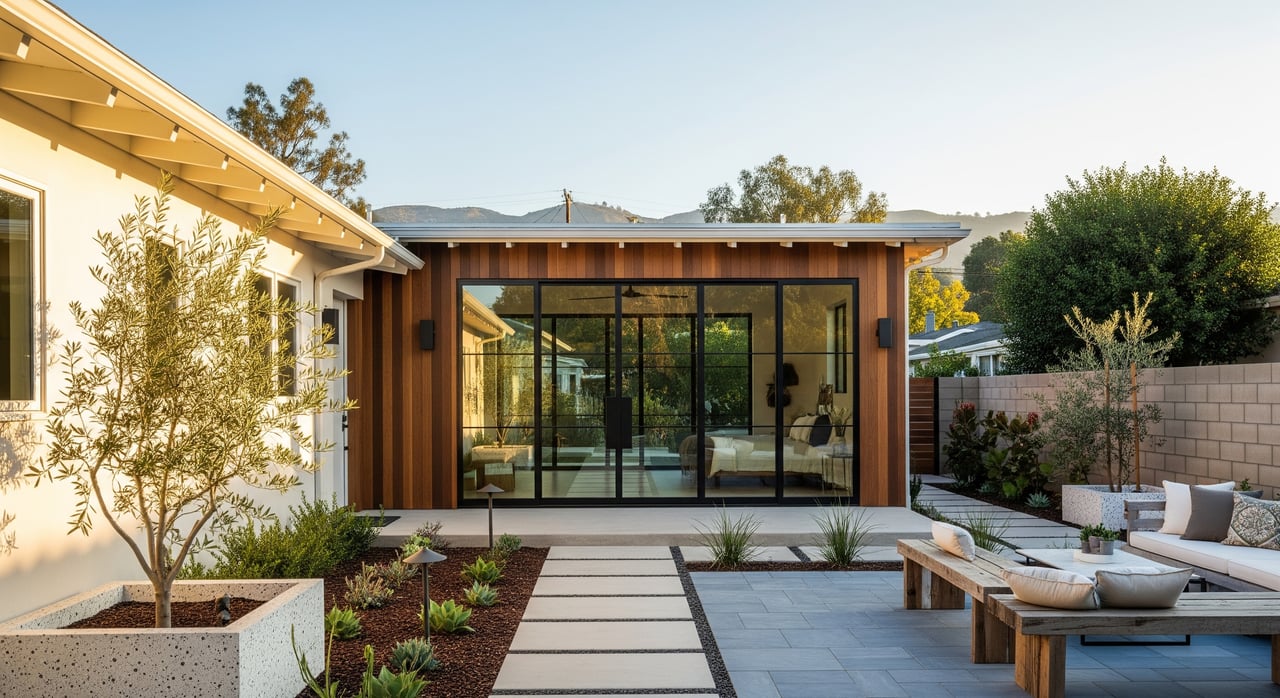
A stand‑alone backyard unit offers the most flexibility for size and privacy, with higher total cost. For roughly 400 to 1,000+ square feet, plan on $150,000 to $450,000+. Larger or high‑end builds over about 800 to 1,000 square feet, or sites needing grading and seismic work, can reach $400,000 to $700,000+.

Two‑unit scenarios

Some lots can support a detached ADU plus a conversion or attached addition. Total costs are higher and can trigger extra requirements, so it’s vital to confirm feasibility early and budget for longer timelines.

What it will cost and how long it takes

Beyond hard construction, build a budget for design, engineering, permits, and utility work. Soft costs often land around 10% to 25% of construction. Local plan check and permit fees can range from several thousand dollars to $20,000+ depending on scope. Utility hookups vary widely: simple connections may be a few thousand dollars, while new sewer laterals or service upgrades can push $2,000 to $50,000+.

Typical timelines in Glendale and the broader LA area:

  • Planning and permit approval: 30 to 90 days if the submittal is complete and no discretionary review is required.
  • Construction: 2 to 9 months for most projects. Garage and internal conversions tend to be faster, while new detached units take longer. Complex hillside or two‑unit projects can run 9 to 12+ months.
  • Inspections and certificate of occupancy: expect additional time after construction for final inspections and utility sign‑offs.

Primary cost drivers to watch:

  • Whether you are reusing existing space or building new.
  • Site access and staging.
  • Sewer lateral condition and stormwater/grade work.
  • Fire requirements in brush zones.
  • Retaining walls and grading.
  • Electrical panel upgrades and utility capacity.

What you can rent it for in Glendale

Rents vary by size, finishes, privacy, and micro‑location. Illustrative ranges for Glendale and nearby LA neighborhoods:

  • Studio or JADU (about 400 to 500 square feet): $1,300 to $2,000+ per month.
  • One‑bed, one‑bath (about 450 to 700 square feet): $1,800 to $2,800+ per month.
  • Two‑bed ADU (700+ square feet): $2,500 to $3,800+ per month.

Treat these as starting points. Before you commit, pull current rental comps within about a mile that match size and amenities, and stress‑test your numbers for a softer rent scenario.

Underwriting your Glendale ADU

Smaller accessory units often underwrite with a 25% to 35% operating and vacancy expense allowance. A common quick formula for net operating income is:

  • NOI = Gross Rent × (1 − expense rate). Exclude mortgage principal and interest from NOI, but include insurance, utilities you pay as the owner, incremental property taxes, and a maintenance reserve.
  • Set capital reserves at 5% to 10% of rent or a fixed annual amount based on age and condition.

Illustrative numbers: one‑bed detached ADU

Assumptions for example only; verify with Glendale comps and quotes:

  • Purchase price: $900,000; 20% down; $720,000 loan at 5.0% (30‑year fixed) → principal and interest about $3,869 per month.
  • Build a detached one‑bed ADU for $200,000 including soft costs.
  • Expected ADU rent: $2,200 per month.
  • Expense allowance: 30% → net rent $1,540 per month.
  • Additional monthly insurance and taxes allocated to the ADU: $150 (varies).
  • Net cash flow from the ADU: $1,390 per month (about $16,680 per year).

Cash‑on‑cash return on ADU cost: $16,680 ÷ $200,000 ≈ 8.3% before taxes.
House hacking effect: offset your $3,869 principal and interest with $1,390 net ADU income, and your effective monthly housing outlay drops to about $2,479 before property taxes, insurance, and maintenance on the main home. This is a simplified illustration to show how the math can work.

Financing paths for owner‑occupants

Treatment of ADU income varies by program and lender. Confirm details with a loan officer early so you know whether projected rent will count for qualification.

Conventional and HomeStyle Renovation

Conforming owner‑occupied loans may consider rental income from an ADU when it is documented or supported by a market rent appraisal, with a common practice of using a percentage of rent for qualifying. The HomeStyle Renovation loan can fund ADU construction in a purchase or refinance when you will occupy the property.

FHA 203(k)

FHA’s 203(k) (limited and standard) can finance rehabilitation that includes ADUs for owner‑occupants. These loans require specific consultants and documentation and may allow rental income with appropriate verification. Lender overlays can apply.

VA options

Qualified VA borrowers can pursue renovation paths or turnkey ADU setups. Treatment of rental income follows VA policy and lender overlays.

Construction‑to‑permanent loans

A separate construction loan that converts to a permanent mortgage can work well for new detached ADUs. Expect full plans, a budget, and higher interim rates during construction.

Cash‑out refinance, HELOC, or savings

For smaller projects like garage conversions, HELOCs or savings can be fast and flexible. Compare the cost of capital against expected ADU yield.

Local and state programs

At times, local jurisdictions or state partners offer targeted ADU loans or grants for affordability or multigenerational occupancy. Keep an eye on Glendale and LA County announcements.

Questions to ask every lender:

  • Will you count projected ADU rental income, and what percentage will you use?
  • Must the ADU be completed and leased before you count rent?
  • Do you require a market rent appraisal or rent schedule?
  • How will the ADU affect my debt‑to‑income and loan‑to‑value calculations?
  • What are the impacts on PMI, loan limits, and down payment?

Risks and what to plan for

  • Construction cost overruns and schedule delays.
  • Rents that underperform early projections.
  • Lender restrictions that limit counting projected rent for qualification.
  • Additional review in historic districts or overlays.
  • Increased insurance, property taxes, or unexpected repairs.
  • Tax implications of renting part of your property; plan for depreciation and future sale treatment with a tax professional.

Due diligence checklist for Glendale buyers

Use this quick framework before you commit dollars:

  • Confirm zoning and ADU allowances for the parcel with Glendale Planning and Building & Safety.
  • Check for historic districts, hillside, or fire hazard zones that affect design and review.
  • For conversions, inspect foundations, egress paths, and mechanicals; scan for plumbing and electrical constraints.
  • Locate the sewer lateral and get clarity on connection responsibilities and potential upgrades.
  • Assess utility capacity, especially electrical panels and any needed service upgrades.
  • Pull 3 to 5 recent local rental comps that match your planned unit’s size and amenities.
  • Gather ballpark quotes from one to three ADU contractors or design‑build teams.
  • Speak with lenders about renovation or construction financing and whether they will count projected rent.
  • Build a realistic budget with a contingency and a timeline based on actual quotes.
  • Model NOI, cash‑on‑cash, and your effective housing payment to make a go/no‑go decision.
  • Consult a CPA on depreciation, expense allocation, and potential capital‑gains impacts.

Your next steps

Here is a simple workflow to move from idea to decision:

  1. Site feasibility: verify basic ADU allowances and any overlays.
  2. Initial pricing: request high‑level quotes for your preferred ADU type.
  3. Market check: confirm rent using hyper‑local comps.
  4. Lender pre‑approach: align on financing and income treatment.
  5. Detailed budget: commission plans or seek fixed bids to lock costs.
  6. Final underwriting: validate NOI and returns against financing terms.

Partner with a local, ADU‑savvy team

If you want a clear path from feasibility to cash‑flowing reality, work with a team that knows Glendale parcels, lender expectations, and ADU buyer demand. We help you identify practical ADU options, price out the work with local experts, and package rental potential to support your goals as a homeowner and investor.

Ready to run the numbers on a specific property or ADU concept? Connect with Petro Real Estate Group - Andrew & Stacy for a friendly, focused consultation tailored to your situation.

FAQs

How long does it take to permit and build an ADU in Glendale?

  • Many ministerial ADU permits take about 30 to 90 days after a complete submittal. Construction typically runs 2 to 9 months, with complex sites or two‑unit plans taking 9 to 12+ months.

What does a garage conversion usually cost in Glendale?

  • Typical garage or interior conversions range from about $40,000 to $150,000, depending on structural work, utilities, and finishes.

Can projected ADU rent help me qualify for a mortgage?

  • It depends on the loan program and lender. Some conventional and renovation loans may consider a percentage of market rent with an appraisal; others require the ADU to be completed and leased first.

How much should I set aside for expenses on an ADU rental?

  • A common rule of thumb for small accessory units is 25% to 35% of gross rent for vacancy and operating costs, plus a 5% to 10% reserve for capital items.

What rent can I expect for a one‑bed ADU in Glendale?

  • One‑bed ADUs often lease around $1,800 to $2,800+ per month, depending on condition, privacy, and micro‑location. Always verify with current comps.

Do smaller ADUs avoid some impact fees?

  • State law often limits certain impact fees for ADUs under 750 square feet. Larger ADUs can face more fees. Confirm details with Glendale’s current schedules.

Work With Us

We pride ourselves in providing personalized solutions that bring our clients closer to their dream properties and enhance their long-term wealth. Contact us today to find out how we can be of assistance to you!